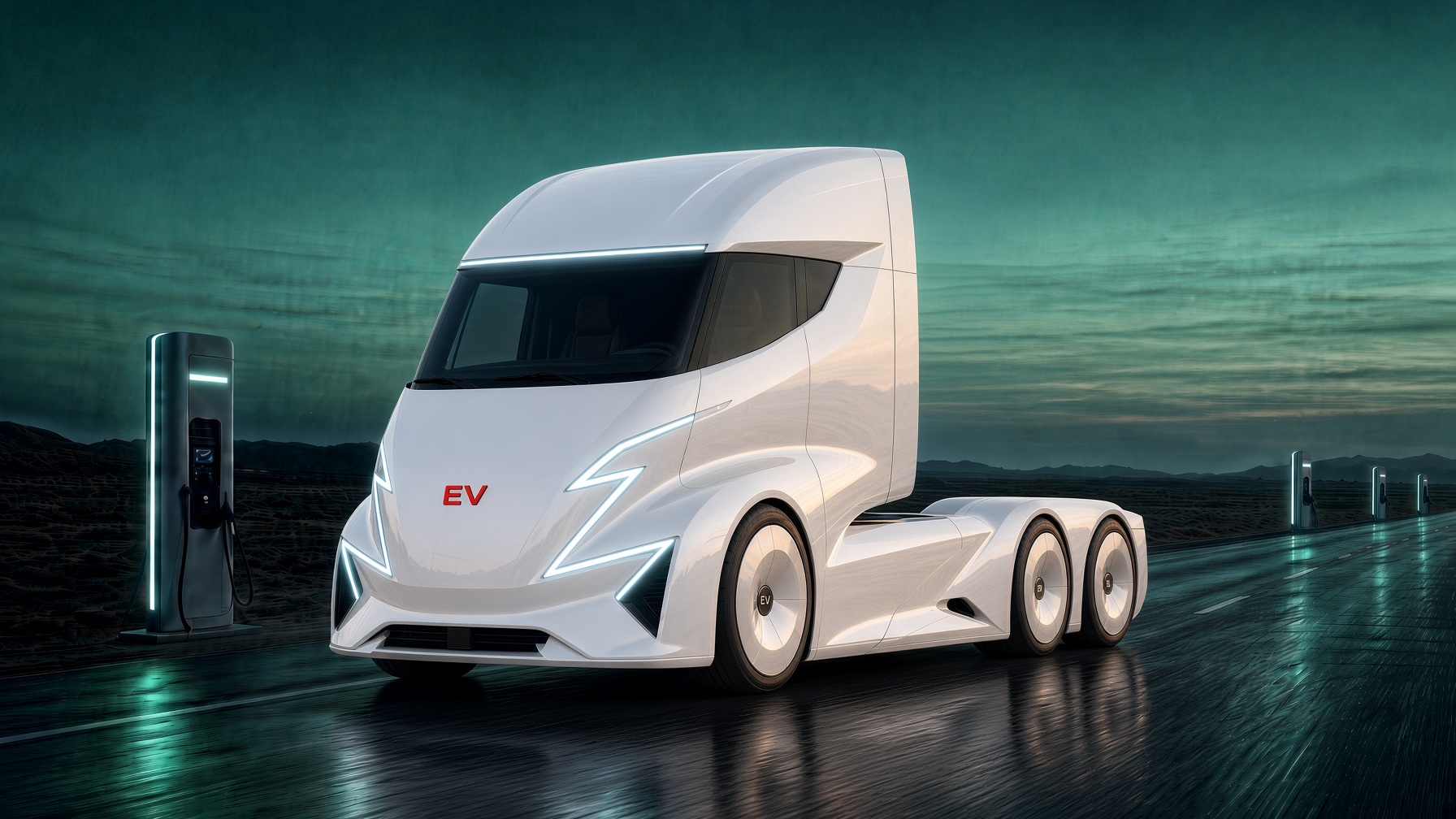
Diesel class-8 fueling is a 15–20 minute island stop. Battery-electric class-8 is not, unless the plug can move megawatts, not the 150–350 kW that passenger CCS was built for.
That is the job of MCS charging hubs: they are the fueling stations for electric semi trucks. Without them, all-electric class-8 stays stuck on short drayage and depot-based loops.
What MCS actually is
MCS is the Megawatt Charging System — a heavy-duty DC coupler developed through CharIN and published in the U.S. as SAE J3271 (Technical Information Report, March 2025). Parallel IEC work covers the same coupler family.
Documented design targets:
- A single high-power conductive plug for large commercial EVs (class 6–8 trucks and buses first)
- Voltage on the order of 1,250 V DC (connector discussions go up to 1,500 V)
- Current up to 3,000 A with cooled cables
- Theoretical peak around 3.75 MW
- Communications on ISO 15118-20 (not the same PLC path as passenger CCS)
CCS (SAE J1772 combo) for trucks typically tops out around 350–500 kW in the field. That is useful overnight or for a regional pack. It is not a diesel-island replacement for a ~800–1,000+ kWh long-haul tractor.
Argonne National Laboratory’s MCS FAQ put the physics in dispatch language: on the order of 1.6 MW is required to put ~400 miles back on a class-8 in a 30-minute break. That 30 minutes is not marketing — it is Hours of Service. If charge time exceeds the legal rest, the electric truck loses the lane to diesel.
Why class-8 all-electric trucking needs hubs
A hub is more than one cabinet in a yard:
- Grid — multiple megawatts in a freight zip code, not a 150 kW light-duty pedestal
- Geometry — pull-through lanes, trailer on, bobtail lanes, turning radius for a 53-foot van
- Duty — many stalls so six trucks at 11:00 do not queue behind one 350 kW plug
- Access rules — public (Greenlane-style CCS today), Tesla Semi Megacharger (Tesla customers), or private MCS (EV Realty Powered Properties)
- Uptime — commercial vehicles need first-attempt starts; SAE’s MCS work explicitly talks reliability, not hobbyist adapters
Without hubs:
- Fleets only electrify what can return to a depot every night
- Spot-market and for-hire Tesla Semi / Electric Semi capacity cannot take a live load 400 miles from home
- Shippers cannot put zero-emission on a tender and mean it
That is the gap EV LoadBoard is built around: freight plus charging on the lane.
What is on the ground in 2026 (verified, not hoped)
- Tesla public Megachargers in Bloomington and Vernon, CA — six stalls, up to 1.2 MW, MC2 / MCS-class, Tesla Semi customers
- EV Realty San Bernardino — 76 ports, 9 MW, CCS to 500 kW and MCS to 1.2 MW, private contracted fleets
- Greenlane Colton — public 40+ stall commercial site, ~400 kW pull-through CCS today, MCS planned as trucks and utility upgrades land
Those three are different products. A yellow Private MCS pin is not a Greenlane public stall and is not a Tesla Megacharger. Each host underwrites each company separately.
CCS is still in the mix
Most electric trucks on U.S. roads still present CCS. Hubs that only speak MCS would strand today’s fleet. The sites that will matter in 2026–2027 do both: CCS for current tractors, MCS for the packs that need a megawatt in a break.
Do not advertise “MCS” if the stall is 400 kW CCS. Do not send a CCS-only day cab to a Tesla Megacharger and expect a session.
How to use this on a load
- Look at the EV Semi charging map. Green = active, red = coming soon, yellow = Private MCS.
- Need a private host (EV Realty and similar)? Submit the fleet at Private Charging Access. Nothing auto-approves a yellow pin.
- Book the freight on evloadboard.com with road miles and a charge stop that the tractor can actually use.
Diesel won because the island was everywhere. Electric class-8 wins when MCS hubs are dense enough that a dispatcher can treat them like fuel. Until then, the honest desk is the one that shows the plug, the power, and the load on the same screen.
Sources: SAE J3271 (March 2025), SAE / Argonne MCS materials, CharIN MCS targets, Tesla Charging 2026 public Megacharger openings, EV Realty San Bernardino 2026 opening, Greenlane Colton public site and MCS roadmap.