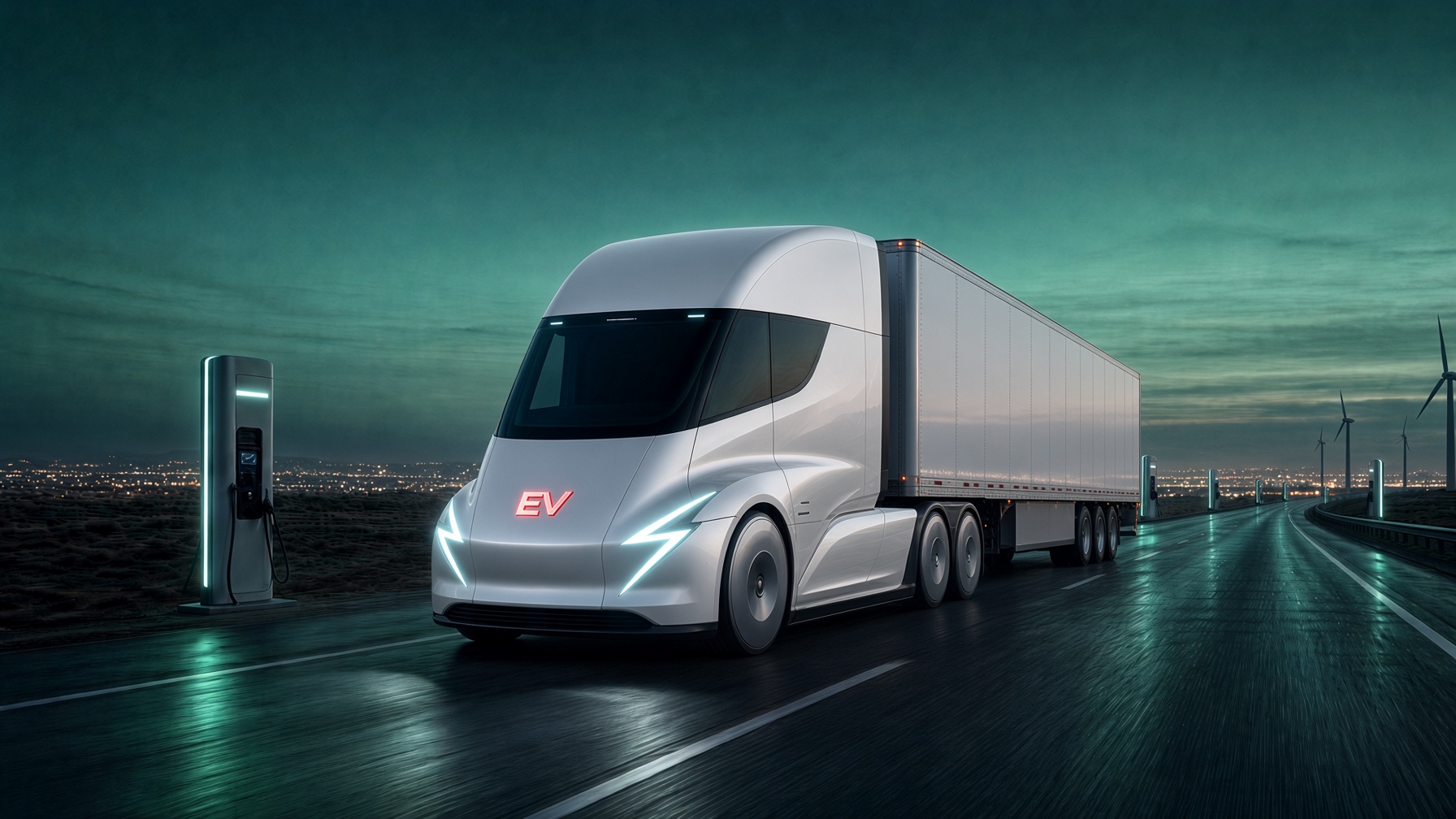
For years Tesla Semi charging was mostly private: factory lots, fleet yards, and a handful of Megacharger sites that did not work like a Supercharger any driver could find. That changed in 2026 when Tesla opened public Tesla Semi Megacharger sites in Southern California.
Facts below are limited to what Tesla Charging, Tesla’s public charging map, and on-the-record trade coverage have shown. Tesla does not publish a diesel-style “open 24/7 to every class-8 brand” directory the way a truck-stop chain does.
What a Tesla Megacharger is
A Megacharger is Tesla’s high-power DC station for the Tesla Semi. It is a different plug and power class than a passenger Supercharger (NACS).
- First-generation public hardware (the small Ontario, CA experiment) was reported at two stalls and about 750 kW, using Tesla’s earlier MC1 connector. That site was later removed from Tesla’s charging map.
- Current public sites use Megacharger 2 (MC2) stalls rated up to 1.2 MW (1,200 kW) and described as aligned with the industry Megawatt Charging System (MCS) coupler.
Tesla has long marketed a ~30-minute Megacharger stop as the operational analog to a diesel island for the Semi. Treat that as Tesla’s product claim; actual kWh in the yard depends on state of charge, battery thermal limits, and site power.
Public sites that are documented open (2026)
Trade press and Tesla Charging posts identify two full-scale public Megacharger plazas in the Los Angeles freight shed:
Bloomington, CA — 18434 Valley Blvd
Opened July 2026. Six pull-through stalls, up to 1.2 MW each. Tesla Charging announced it as a public Megacharger for Tesla Semi customers. Independent coverage called it the first full-scale public Megacharger after the smaller Ontario lot came off the map.
Vernon, CA — 3130 Bandini Blvd, 90058
Opened August 2026. Same published layout: six stalls, up to 1.2 MW. Industrial band between downtown Los Angeles and the port/distribution complex.
Both sit on the path between the Ports of Los Angeles / Long Beach and Inland Empire warehouses — the same geography where early Semi freight actually runs.
Tesla still operates private Megacharger capacity tied to manufacturing and fleet routes (including sites historically associated with Lathrop, CA and Sparks / Gigafactory Nevada). Those are not the same as the public Bloomington and Vernon lots.
Who can plug in
Public Tesla Megachargers, as announced, are for Tesla Semi customers — not a guarantee that every MCS truck on the road can authenticate and charge. Tesla has also marketed Semi Charging for Business so fleets can put Megacharger / depot hardware on their own property.
If you run a non-Tesla electric tractor, do not assume a Tesla Megacharger is your fuel stop. Check connector, account, and the charging map.
Network still being built
Tesla’s charging map has shown additional planned Megacharger pins across U.S. freight corridors (including I-5 in the Pacific Northwest). A lease for a Semi charging site in Chehalis, Washington was reported in 2026. Planned is not open. EV LoadBoard will keep coming-soon pins red until the desk can verify a live stall.
Using Tesla Semi charging with a load
- Confirm the tractor is a Tesla Semi (or otherwise actually accepted at that Megacharger).
- Check Bloomington, Vernon, or a verified depot on the EV Semi charging map.
- Book freight that fits range plus that charge stop on evloadboard.com.
- Do not treat a planned pin as a fuel island.
Tesla Semi freight still needs a loadboard that shows miles, rate, and charging together. That is EV LoadBoard — not a passenger Supercharger app.
Sources: Tesla Charging site posts (Bloomington July 2026, Vernon August 2026), Tesla public charging map listings, Automotive World, Drive Tesla, EVwire.